
Kampai Budokai recommended literature
This page lists books I own or have read recently, many are good and some are not-so-good (but listed anyway so you can avoid them). For your information, short descriptions are added to each title, reflecting my opinion on them. I'm limiting this to books available in English. All opinions are my own of course.
Some of the authors have their own web presence. I add links to every author I find (please let me know if I missed one).
We used to be an Amazon.com associate, but given how they've shown themselves to practice bigoted forms of censorship and have told pathetic lies about it when caught (the event known as AmazonFail) we can't recommend them anymore.
Contents
- Rating system
- Books on Aikido
- Books on Japanese swordsmanship
- Books on Japanese swords and armor
- History, philosophy and other fun stuff
- Books on other arts
- Self defence books
- Of general interest
- Fiction
- Movies
- Music
Rating system
Good or excellent books can get from one to five beers:  No beers means I didn't really like the book. Really bad books get the
Horrible Glass of Water:
No beers means I didn't really like the book. Really bad books get the
Horrible Glass of Water: 
New Reviews
Books on Aikido
Gozo Shioda
(visit the International Yoshinkan Aikido Federation)
Total Aikido, the master course. Gozo Shioda, Yasuhisa Shioda,
Kodansha international 1996.
Shioda's books are good, offering extensive instructions and comments with
clear and helpful photographs. They are well written and useful even if
you're not in Yoshinkan. Recommended.
Dynamic Aikido. Gozo Shioda, Kodansha international 1968.
Also a very instructive Aikido book, though less complete than the later
"total aikido" (it features less techniques). It does however contain
a section on self-defence.
Angry White Pyjamas, an Oxford poet trains with the Tokyo riot
police. Robert Twigger. Indigo, 1997.
Books on Aikido by people who can actually write are rare. Even rarer are
books that don't try to idealise all things Japanese. Robert Twigger tells
about the Yoshinkan senshusei course he took and life in Tokyo in general.
Some people have commented he puts too much emphasis on the negative aspects
of his experience, but I don't feel his account sounds exaggerated at all,
it's just not very congratulatory. We all know many people quit martial
arts after obtaining a certain grade. Most don't write a book about it though.
Gaku Homma
(visit the Nippon kan)
Aikido for Life. Gaku Homma, North Atlantic Books, 1990.
My favorite Homma book. Collection of essays on Aikido, reflecting a
beginner's course. His debunking of the unbendable arm demonstration alone
is worth the price. Illustrated by line drawings.
Children and the martial arts, an Aikido point of view. Gaku
Homma, North Atlantic books, 1993.
What I like about Homma is his honesty, he usually says exactly what it's
about. This book could be blamed for a heavy Aikido bias, but then the title
says so, doesn't it? What do you want your child to learn in martial arts,
Homma asks, what kind of techniques do you want your child to use on its
friends? The book contains a large part of autobiographical reflection on
a Japanese child's education. The technical section also includes games
to make class more interesting to children.
The structure of Aikido, vol. 1, kenjutsu & taijutsu. Gaku
Homma, Frog Ltd, 1997.
Homma explores the relation between sword and empty hand movements in his
usual straightforward writing style, with well done photographs.
Aikido Sketch Diary : Dojo 365 Days. Gaku Homma, Yutaka Kikuchi
(Translator). 1994.
This book describes the operation of the Nippon kan over an entire year.
It includes a lot of information on Homma's uchi deshi program. Illustrated
with Homma's humoristic drawings.
The Folk Art of Japanese Country Cooking, a traditional diet
for today's world. Gaku Homma, North Atlantic Books, 1991.
This isn't just a collection of recipes, but an introduction to Japanese
folk art through cooking. Interesting for us martial artists biased towards
upper class samurai aspects of Japanese culture. Contains material on Homma's
work at the Lake Ogawara folk art museum. Illustrated by BW photographs
and drawings (and it has at least one photograph from Ueshiba's Iwama hideout
to justify its inclusion with the Aikido books). Also comments on the supposed
health value of Japanese cuisine.
Ueshiba family
(visit the Aikikai hombu)
Budo training in Aikido (Budo renshu). Ueshiba Morihei, Sugawara
Martial Arts Institute, 1997. 165 techniques explained in drawings,
and a theorethical introduction which appears to be almost the same as
in "Budo", except that in this translation it actually makes some sense
(contrary to Stevens' work).
Budo, teachings of the founder of Aikido. Morihei Ueshiba, introduction
by Kisshomaru Ueshiba, translation John Stevens, Kodansha, 1991. A
photographic manual by Morihei himself. Also a series of photographs from
Noma dojo, 1936, contrasted with pictures from Wakayama, 1951. These photographs
are without comment and some seem to be placed together haphazardly. Interesting
book for the pictures, but read the text in the new Budo renshu translation
instead. I particularly dislike the pretentious phrases on the cover.
The spirit of Aikido, Ueshiba Kisshomaru, Kodansha, 1984. Some
essays on the purpose, and history of the dissemination of Aikido. No
techniques, some photographs. I appreciate the section on the importance
of the sword to Aikido in this book.
Aikido, Kisshomaru Ueshiba, Hozansha, 1985. The best
reference for Kisshomaru's Aikikai Aikido.
Other
Aikido in Everyday Life : Giving in to Get Your Way. Terry Dobson,
Victor Miller. North atlantic Books, 1993. An interesting presentation
of conflict resolution in terms of circle, triangle and square, which
is somehow related to Aikido according to Dobson. The examples are unfortunately
mostly in a rather silly self-help-book-style, probably a mark of the
time this was written.
Aikido : The Way of Harmony. John Stevens, Shirata Rinjiro. Shambala,
1984. The biography of Ueshiba included in this book contains
some curious anecdotes. Shirata Rinjiro explains several techniques by
paired sword interpretation of the principles, which is interesting.
The Essence of Aikido, spiritual teachings of Morihei Ueshiba.
John Stevens, Kodansha international, 1993. Another one by John
Stevens, again with a lot of interesting photographs. Contains doka in
original Japanese and calligraphy by Morihei. The chapter on "the aikido
universe" leaves one to think that aikido techniques are actually just
mystical handwaving in a system of magic.
Aikido, the arts of self-defense. Koichi Tohei, Rikugei publishing
house, 1961. and This is Aikido. Koichi Tohei, Japan
Publications, 1968. These two books are very similar in content,
the more recent one is more developed, so I would choose that one first.
Both are out of print. The older one has some historic interest pictures
that are not in "this is aikido" however. It has 50 techniques or "arts",
which are assembled in 36 groups in "this is aikido". The techniques are
named: ikkyo, nikyo, sankyo, shiho-nage, kote-gaeshi, kokyu-nage and kaiten-nage.
Each have an irimi and omote application. Tohei focuses heavily on mind
and body integration, but this does NOT mean half of the training time
should be filled with talk on ki or kokyu. "If I explain you may think
you understand", he says, "but without experience it means nothing". In
other words; don't talk, practice. Note that Tohei was still with the
Aikikai at the time. Visit Ki
Aikido USA.
Unlocking the secrets of Aiki-jujutsu. H. E. Davey. Master Press,
1997. Not really an Aikido book, I put it here for convenience.
Davey is current head of Saigo ryu Aiki-jujutsu (this may sound dubious,
but trust this one). His book has some minor layout defects, but contains
a very good explanation on jutsu and do (Draeger wasn't wrong, he was
misunderstood), the history of Aiki-jujutsu, and a great chapter on myths
and misconceptions (I have a black belt in jujutsu, what do you mean,
"which ryu?" etc.), and explanations of Aiki principles that made me realise
a few mistakes in my understanding.
Complete Aikido. Aikido Kyohan: the definite guide to the way
of harmony. Roy Suenaka, Christopher Watson. Tuttle, 1997. While
the title sounds a tad pretentious, I found this a highly enjoyable book.
The first half is the story of the authors martial arts career, which
is particularly interesting for the light it sheds on the disintegration
of the Aikikai when Tohei and Ueshiba Kisshomaru grew animous. The technical
section is well presented and quite good, but hardly 'complete'.
Aikido and the Dynamic Sphere : An Illustrated Introduction.
Adele Westbrook, Oscar Ratti. Tuttle, 1994. Beautifully illustrated
book, you have to like it even if you don't agree with Westbrook&Ratti's
view on Aikido philosophy. Techniques list is rather complete, but the
names given for them are a bit non-standard I think.
Bokken, Art of the Japanese Sword. Dave Lowry, Mike Lee (Photographer).
Ohara, 1985. Basics of bokken practice, intended as a supplement
for unarmed Aikido practice. Mostly basic movements and a few kumitachi.
Illustrated by photographs. If elements from Lowry's Shinkage ryu training
were included in the book, it isn't specified in the text. Not a terribly
impressive book. Not that there is anything wrong with the techniques,
but if the author had put a bit more emphasis on the fact that there are
other authentic ways to handle a sword, we might encounter less Aikidoka
believing they know the One True way to hold a sword or perform zarei
or cut the air.
Invincible Warrior : A Pictorial Biography of Morihei Ueshiba,
the Founder of Aikido. John Stevens. Shambala 1997. This is a
remake of Abundant Peace : The Biography of Morihei Ueshiba, Founder of
Aikido, which was published in 1987. It contains a lot of interesting
photographic material illustrating the life of Morihei Ueshiba. The biography
as written by Stevens contains a lot of questionable attempts to suggest
uncle O'Morri had some kind of supernatural power. These stories seem
to change with each retelling. Some might say the influence of Takeda
is downplayed. The retail price is a bit high for this book too (I got
it on a special sale).
Training with the Master, lessons with Morihei Ueshiba, founder
of Aikido. John Stevens and Walther v. Krenner. Shambala, 1999. This
is mostly a photo album by Krenner, following Morihei around wherever
he goes, so we get to see him with and without his dentures. Quite nice,
but not much about Aikido techniques. There is an introduction by Stevens,
and the book closes with the collection of sayings known as 'the art of
peace'. Expensive when not on a special sale.
The Secrets of Aikido, the hidden teachings and universal truths
of Aikido, as taught by its founder, Morihei Ueshiba. John Stevens. Shambala
1997. More of Stevens' bizarre theories, linking aikido with
alchemy, tantric sex magic, and the new testament. The technical photographs
(including such things as a tengutobigiri or "flying tengu cut") feature
Stevens himself, sometimes Shirata Rinjiro. Contains 4 pages of "secret"
aikido kotodama. Somewhat amusing.
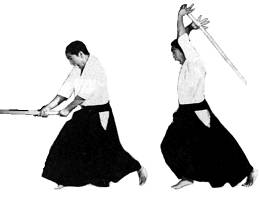
Aikido, its heart and appearance. Morihiro Saito, Sugawara Martial
Arts Institute, 1975. I saw Saito's multi-volume series "traditional
aikido" years ago, and at the time I was impressed. I didn't practice
a ken or jo art yet at the time. This book is of course far less detailed,
containing 7 sword suburi, 7 kumitachi, no aiki-jo at all, and only a
few examples of each of the major holds and throws. The book is a nice
reminder of Sato's sword forms, but I'm very unimpressed with the people
he got to pose with him on the pictures.
I scanned this picture as a hopefully adequate illustration of what I
mean:
The Principles of Aikido. Mitsugi Saotome, Shambala, 1989. This
is mostly a techniques book, showing unarmed as well as some sword and
stick techniques from Saotome's system. Techniques qre shown in many clear
photographs with some explanation, as well as some history and philosophy
edited by Irene Wellington from lectures and writings of Saotome. A well-produced
book but rather specific to Saotome's school.
Aikido and Chinese Martial Arts. Volume 2: Aikido and Weapons
Training. Tetsutaka Sugawara, Lujian Xing, Mark B. Jones. Sugawara Martial
Arts Institute, 1998. A rather strange book; the first half deals
with some kind of Aiki-jo, the second half with Chinese straight sword,
and hardly any connection is made between both parts - which I found rather
disappointing. Also included is a very small yet interesting part on the
history of iron smelting and forging in Japan.
Samurai Aikijutsu. Toshishiro Obata. Dragon Books 1987. A
small book of 'aikijutsu' techniques demonstrated by Obata in clear photographs.
It contains a short Daito ryu and Aikido history. I particularly like
the conclusion though, where Obata voices some strong opinions on current
Aikido practice.
The Hidden Roots of Aikido : Aiki Jujutsu Daitoryu. Shiro Omiya,
Kodansha, 1998. Basic, intermediate and advanced Daito ryu techniques,
explained in photographs. The book doesn't say much on Omiya's background,
but the explanations are interesting. I particularly appreciate the short
bits called 'kuden' intermixed with the techniques. (example: guinomi
kuden; raise your opponent's fingers as if taking a sip of sake.)
Books on Japanese swordsmanship
Japanese Swordsmanship, technique and practice. Gordon Warner,
Donn F. Draeger, Weatherhill, 1996. This book first appeared
in 1982, and many of the technical details have since changed. Each technique
has dual descriptions strangely labeled "former combative application"
and "modern spiritual application". Illustrated by photographs of people
like Mitsuzuka Takeshi and Otake Ritsuke demonstrating techniques, as
well as various useful skills such as decoratively tying the sageo around
the saya or the cords around the swordbag. Most interesting though is
the introduction on the sword in Japanese history and development and
meaning of iaido, which admirably refrains from the mythologisation of
the samurai rampant in most martial arts books.
Flashing steel, mastering Eishin ryu swordsmanship. Masayuki
Shimabukuro, Leonard Pellman, Frog 1995. This book covers most
of the ryu, history, philosophy, omori, chuden, okuden, tachi uchi no
kurai, seitei and tameshigiri. I don't practice Eishin ryu myself, but
still have my reservations regarding some of the things going on in the
photographs, esp. in the seitei section. Often there are too few photographs,
or they seem poorly chosen. For example, the three variations of itomagoi
are illustrated with exactly the same sequence of pictures (also used
for nuki uchi), which is reproduced three times and shows nothing between
seiza and furikaburi. A useful book for those who want a quick reminder
for all the series in one volume, I guess.
Practice drills for Japanese Swordsmanship. Nicklaus Suino, Weatherhill,
1995. A book with single and partner drills using bokuto. The
practice of letting the point drop down behind the back before striking
could cause problems in some styles. Drawings are rather dull computer
graphics. His advice on advanced practice is worth repeating: advanced
practice consists of the basic drills, performed by the advanced practitioner!
Iai, the art of drawing the sword. Darrell Craig, Tuttle, 1981.
Contains seitei kata 1-7, without sageo handling (somewhat dated).
The book also contains some katas from Mugai ryu, and various stories
(including the 47 retainers). Drawings are rather unprofessional and uneven
in quality. Not the best book around, but certainly worth having. Visit
Craig's Houston
Budokan.
Jodo. Yoneno Kotaro and Hiroi Tsunetsugu . English translation
of the Jodo Kyoten by Eishin kan dojo, 1985. ZNKR Jodo. Quite
good, though the choice is limited concerning translated Jodo literature.
Kenjutsu : The Art of Japanese Swordsmanship. Charles Daniel, Unique Publications, 1991. Not very good. Read the detailed review here.
Shinkage-Ryu Sword Technique : Traditional Japanese Martial Arts.
Tadashige Watanabe. Some Shinkage-Ryu katas demonstrated in photographs
with minimal explanation.
Japanese Sword Drawing : A Sourcebook by Don Zier. Unique Publications,
2000. The first book in English on Muso Shinden ryu Iaido. It
describes almost all the kata from the shoden, chuden and okuden set,
as well as the standard forms of the ZNKR and ZNIR. Kanji are provided
for all kata names, and photographs are numerous and clear. Explanations
are very sketchy though, and the execution itself looks like someone who
has practiced in isolation for the last couple of decades, and would be
considered "wrong" by many practitioners of the style. The introduction
is rather weak. This book is for Muso Shinden ryu what Flashing Steel
is to Eishin ryu (though with better pictures but less phylosophy): an
illustrated catalog of the ryu's katas.
Looking at a far mountain - a study of Kendo Kata. Paul Budden,
Tuttle, 2000. A detailed explanation of the Kendo no Kata, illustrated
with photographs and drawings. Also includes some history, lineage charts,
a glossary, and a number of historic photographs. Recommended for anyone
interested in the Kendo kata.
Books on Swords and
armor
The Craft of the Japanese Sword. Leon & Hiroko Kapp, Yoshindo
Yoshihara, Kodansha International, 1987. A beautiful book with
pictures dealing with sword forging, polishing and habaki and shirasaya
making. Lacks tsuka and tsuba production though.
Arms and armor of the samurai, the history of weaponry in ancient
Japan. Bottomley & Hopson, Crescent books, 1996. Beautiful
book, also contains armor lacing diagrams for various periods. Jock told
us the publisher cut at least a third of his text in favor of bigger pictures.
Still one of the nicest books on Japanese arms I know of.
The connoisseur's book of Japanese swords. Kokan Nagayama, Kodansha,
1997. A voluminous book dealing solely with sword blade appreciation,
organised according to the 6 traditions. Very interesting manner of representing
the blade surface in the drawings.
Samurai Sword, a Handbook John M. Yumoto, 1958. Good
introduction for aspiring collector, somewhat specific to the American
sword market.
Swords, and hilt weapons. Barnes&Noble Books 1993 Peter Connelly,
editor (various authors). This oversize illustrated work consists
of a number of loosely related essays on swords, knives and other cutlery.
The start is more or less chronological with more emphasis on post-1700
history, ending with modern fighting knives. The book then switches two
swords of Islam, Japan, Asia, India, Africa and pre-conquest America.
The part on the Japanese sword is written by Victor Harris (of the infamous
gorinnosho translation). The book contains many interesting and nice illustrations
and information, but is somewhat incoherent in its organisation. You will
have to go to Barnes&Noble to obtain the reprint (perhaps you would
go through Koryu
Books and support them?)
Arms and Armor of the Medieval Knight, an illustrated history
of weaponry in the Middle Ages. David Edge, John Miles Paddock. Crescent
Books, 1996. A nicely illustrated history, contains pictures
of most of the famous surviving swords and armors. Also deals briefly
with armor construction.
The Armourer and his Craft. From the XIth to the XVIth Century.
Charles Ffoulkes. Dover Publications, 1988. This is a reprint
from a 1912 classic work on the subject. It contains several authentic
texts in full, a polyglot glossary, and an interesting study of the weight
carried by soldiers in history (1550: armor and helmet; 25lb, clothes
and arms; 15lb. - 1911: British infantry service equipment; 59lb 11oz).
It also deals with leather and textile armor. Recommended.
The Book of the Crossbow. Ralph Payne-Gallwey. Dover Publications,
1995 (orig 1903). A treatise on the construction and use of this
often overlooked weapon through the centuries. The details on construction
of the several models are sufficiently explicit that one is tempted to
try and build one. There is even a preparation for poison arrows included.
Flanders' famous crossbows are not neglected. It also includes the Chinese
repeating crossbow and some material on the Turkish bow. There is an appendix
on siege engines, with reconstruction plans by the author.
Arms and armour of the crusading era - 1050-1350 - Western Europe
and the Crusader states. David Nicolle. Greenhill Books, 1999. A
collection of some 2000 line drawings drawn from artwork as well as artefacts,
organised by country. Each drawing is commented. Though the drawings often
lack some detail compared to the original artworks and the text is minimal,
the book is nevertheless a great reference for graphic source material.
Techniques of Medieval Armour Reproduction - the 14th century.
Brian R. Price, Paladin Press, 2000. A voluminous, very nicely
illustrated work on armour making. It deals with modern reproduction rather
than historic armourers though, and is limited in scope to 14th century
armour. Also scarce are actual patterns. On the other hand the book has
detailed information on materials, tools and techniques.
Ancient Chinese Weapons - a martial artist's guide. Yang Jwing
Ming, YMAA Publications, 1999. A list of some 80 Chinese weapons
with short descriptions and drawings, classified as long, short, soft
and projectile weapons, and shields and armor. The book unfortunately
does not cover war engines. Also, the drawings are not very detailed -
this is particulary evident in the section on armor - and explanations
on the use of the weapons are very sketchy.
History, philosophy
and other fun stuff
Karl Friday
(visit Kashima Shinryu North America)
Karl Friday is a Japanese history professor and koryu practitioner with a dual mission: to bring some sense of historical reality to the martial arts literary community, and to bring some practical experience to the field of Japanese historical research.
Legacies of the sword, the Kashima Shinryu and samurai martial
culture. Karl F. Friday with Seki Humitake, University of Hawaii, 1997.
The importance of this book can't be stressed enough, though
others have done so better than I can. According to the introduction,
this book started as a translation of a how-to book, that turned out to
become much more. I wish the technical explanation (which were of necessity
downplayed in the context of the book) will see separate publication someday.
Highly recommended (you absolutely must have this).
Hired swords, the rise of private warrior power in early Japan.
Karl F. Friday, Stanford University, 1992. The historical evolution
of conscript armies to samurai. Not much on budo as such and not really
aiming at the general public, but valuable to those wishing to understand
the roots of the samurai. Few illustrations, dissertation style (well,
it IS a dissertation).
visit Koryu Books
Koryu Bujutsu, classical warrior traditions of Japan, Diane Skoss,
ed. Koryu Books, 1997. The first collection of essays and interviews
on Koryu collected by former editor of Aikido Journal. Interestingly,
the various authors sometimes contradict entirely. My main problem with
this book is that I wanted more! Koryu Books
have their own (very interesting) website.
Sword & Spirit: Classical Warrior Traditions of Japan,
Vol 2. Diane Skoss, ed. Koryu Books, 1999. is available
now. The entries in the ryu guide are expanded (as requested by many).
The first part studies Takeda clan writings that shaped later thoughts
on Bushido. Meik Skoss did a puzzling interview with Saito Satoshi on
shurikenjutsu: I thought the fan was used to move air or bash someone
on the head, but it seems the Koga ninja used it to solve trigonometric
and differential equations??? (and then Meik just switches the topic!).
Liam Keeley writes on Tatsumi ryu, Karl Friday writes on kata (mostly
repeating the chapter in Legacies of the sword) and the book ends with
Nishioka Tsuneo discussing uchidachi and shidachi in Shindo Muso ryu.
Others
The face of battle, a study of Agincourt, Waterloo and the Somme,
John Keegan, Pimlico, 1976. A study of three major battles from
the soldiers' point of view. Contains many valuable observations, although
his conclusion that "battle has already abolished itself" seems a trifle
too optimistic.
Lives of master swordsmen. Makoto Sugawara, the East Publications,
1988. This book seems to be out of print. Great biographies of
the most important Japanese swordsmen, founders of some of the most influential
ryu. Interesting illustrations.
A book of five rings, Miyamoto Musashi, Victor Harris, 1974.
I would like that someday someone familiar with Niten Ichi ryu
would translate the gorinnosho. Also, don't read Harris' introduction,
it's full of historical errors. Read "lives of master swordsmen" instead
for a biography of Musashi.
The book of five rings, Miyamoto Musashi, Thomas Cleary, Shambhala,
1994. Slightly different translation, and at least doesn't include
any bizarre "history". Be careful when ordering, there is a pocket edition
of this book which doesn't include Yagyu Munenori's family traditions
on the art of war, a fact that isn't exactly emphasised on the order page.
Legends of the samurai, Hiroaki Sato, Overlook press, 1995. Collection
of interesting stories, anecdotes and samurai writings, in which the oldest
available material was consistently used, instead of a modern retelling.
It contains a partial translation of Musashi's book of five rings. With
drawings.
Autumn lightning, the education of an American samurai. Dave
Lowry, Shambala, 1995. Autobiographical story of Lowry's Yagyu
shinkage ryu training, mingled with retellings of bits of Yagyu history
(which can also be found in Lives of master swordsmen). Some illustrations.
Persimmon Wind, a martial artist's journey in Japan. Dave Lowry,
Tuttle, 1997. The sequel to autumn lightning, in which Dave visits
his sensei in Japan. Illustrated with photographs (there's even a nude
scene!) His writing seems to be improved. I think I'm going to have a
look at his other books soon.
Sword and Brush, the Spirit of the Martial Arts. Dave Lowry,
Shambala, 1995. Short explanations of 42 well-known (or less
well-known) martial arts related Japanese concepts, supported by an analysis
of the characters. Also contains a very short background on calligraphy.
Secrets of the Samurai, the Martial arts of feudal Japan. Oscar
Ratti, Adele Westbrook, Tuttle, 1973. Almost exhaustive survey
of western pre-1970 martial arts literature, with heavy aikido bias. Interesting
mix of facts and fiction and classic demonstration that one should strive
to use primary sources when writing a book. Not that it's actually bad,
just biased and at times misleading. The average paragraph starts with
many disclaimers but nevertheless usually ends in some absolute statements.
Illustrations of techniques seem to draw mostly from samurai movies and
a rich imagination.
Warriors of Japan, as portrayed in the war tales. Paul Varley,
University of Hawaii, 1994. Lots of info from the war tales.
No attempts at poetic rendition of the tales themselves though. Explains
why the war tales are all so depressing.
Musui's story, the autobiography of a Tokugawa samurai. Katsu
Kokichi, University of Arizona 1988. The book that shaped the
morality and spirit of Budo of the Tokugawa samurai. NOT! Musui's story
tells us what being samurai in time of peace was really about: brawls,
extortion, pyramid schemes, etc. Illustrated with period artwork. The
translation attempts to capture a certain flavor, which I'm not sure really
succeeds if one is not familiar with the affected idiom.
A daughter of the samurai. Etsu Inagaki Sugimoto, Tuttle, 1966.
What living in a Meiji era former samurai family was like. An
autobiography. Etsu goes to the US with her husband, then returns to Japan
with her children after his sudden death. Interesting case of multiple
culture shocks. Contains some questionable statements of historical 'fact'
that should be taken as author's belief. A very nice read though.
The sword and the mind. Hiroaki Sato, Overlook press 1985. Translation
of the heiho kaden sho, fudochi shinmyo roku and taia ki. Includes original
illustrations and a very interesting introduction containing some details
on the relation between Munenori and Iemitsu. Don't expect to figure out
all the catalogued techniques though.
Sun Tzu, the art of warfare. The first english translation incorporating
the recently discovered Yin-ch'ueh-shan texts. Roger Ames, Ballantine
books, 1993. Roger Ames is professor and head of the Chinese
studies dept. of the university of Hawaii. The translation has the Chinese
original on one side, and there are no comments and explanations by the
author, it is just a translation. The introduction is interesting and
contains some important points on translating: Chinese words have several
possible meanings, and most translator use the meaning that makes the
most sense in a given context. Ames argues that one should instead try
to make all possible meanings fit in the context to understand the true
meaning of a text, because by not doing so we only project our own culture
back on the Chinese text, and learn nothing on the Chinese worldview,
which should be the point of the translation. The additional material
is quite different in style from the core text, and consists of question
and answer sessions, some are very fragmentary.
For older translations, Ames recommends Griffith, (and so do I) who was
an experienced soldier himself, unlike Cleary for example. Griffith also
includes an analysis of the use of Sun Tzu by chairman Mao and by the
Japanese in WWII.
The Lost Art of War, Sun Tzu II, Thomas Cleary, Harper, 1997.
This is a translation of Sun Bin the mutilated, the long lost work by
a descendant of Sun Wu, that was unearthed a few decades ago. The style
is similar to the lost chapters of Sun Tzu, and part of the work could
be seen as an explanation of the sometimes cryptic statements in the older
work. Parts of the text are still missing or fragmentary. Apparently there
were some changes in war technology, because Sun Bin besieges walled cities
on occasion. The format consists of translation in bold, followed by commentaries
by Thomas Cleary. The work concludes with a summary of common concepts
in Sun Wu and Sun Bin. Some of the commentaries seem to have little relation
to the translated text, in my opinion. Also, Cleary's attempts to translate
the strategies into business management terms are contrived and distracting.
I never did like that Tom Cruise movie either.
Spec Ops : Case Studies in Special Operations Warfare : Theory
and Practice. William H. McRaven, Presidio 1998. The author presents
a theory of special operations based on the concept of relative superiority,
which is achieved by simplicity, security, repetition, surprise, speed,
and purpose, represented on a "relative superiority graph". The case studies
are interesting.
Greece and Rome at War. Peter Connolly, Stackpole Books, 1998.
This combines stuff from earlier books by the author with new
material and very nice artwork. Reconstructs weapons, armor and tactics
of Greek and Roman armies. Also describes the Celts and other enemies
of Rome. Recommended.
Zen and Japanese Culture. Daisetz T. Suzuki, 1993. The
basic idea of this book is that religion shapes culture and not vice versa.
To quote: "let us imagine (Japan without Buddhism), the country would
look like a deserted house with no furniture, no pictures, no screens,
no sculptures, no tapestries, no gardens, no flower arrangements, no No
play, no art of tea, and so on." Suzuki is a Zen Buddhist and he's advertising,
and a bit unconvincing at times. Zen and the samurai, and Zen and swordsmanship
fills a large part of this book. He puts a strange emphasis on the "virility"
of zen (presumably as opposed to "effeminate" tendai and shingon?), and
his use of the Tai Hei Ki as documenting the religious persuasion of its
protagonists rather than of its authors or their patrons is somewhat questionable.
I think it's strange that there seem to be more zen masters referring
to swordsmanship, than swordsmen referring to zen. Zen masters in the
stories are quick to claim mastery of the sword, while the connection
of the swordsman to zen is often rather contrived; if the samurai kills
without a second thought, it's because he views the enemy as an illusion,
which is very zen. If he tries not to kill, he is compassionate, which
is zen too. If he gets himself killed, that is even more zen. Seems the
poor samurai is an example of zen whether he wants to or not. What could
be the cause of this fascination for the art of killing from the zen practitioners,
and their willingness to ascribe zen motives to professional killers?
Gay Tales of the Samurai. Ihara Saikaku, Alamo Square Press,
1995. I wasn't paying attention, thinking it were going to be
merry tales, but the book deals with the Japanese practice of
shudo (pederasty) as described in extracts from the works of Ihara Saikaku.
This book is a retelling of a 1930 english translation of a french translation
by Ken Sato, and this definitely shows in the awkward style and some of
the most horrid romanizations one can encounter.
The Art of Warfare in Western Europe during the Middle Ages,
from the eighth century to 1340. J.F. Verbruggen, The Boydell Press, 1998.
English translation of this excellent Belgian classic from 1954.
Probably one of the best books on the subject, and in an enjoyable translation
(which corrects some of Verbruggen's school-teacher style).
On War. Carl von Clausewitz. edited and translated by Michael
Howard and Peter Paret, Princeton University Press, 1976. This
is a classic, but unfinished work, it's huge and somewhat unstructured,
but not as inaccessible as it's sometimes described.
The Book of Deeds of Arms and of Chivalry. Christine de Pizan,
Pennsylvania state university press, 1999. A 1410 book dealing
with strategy (mostly based on Vegetius) and with laws of war, also giving
detailed lists of fortification and siege equipment (and written by a
woman).
The Art of War. Niccolo Machiavelli. Intro by Neal Wood. Da Capo
Press, 1965. The intro by Neal Wood makes much of 'the art of
war', claiming it to be a kind of synthesis of Machiavelli's socio-political
theories, but I think this is a bit exaggerated. Originally published
in 1521, it's interesting to compare it with the Book of Deeds of Arms
and of Chivalry by Christine de Pizan from 1410. Personally I like the
earlier work more, Machiavelli's emphasis on the superiority of the Romans
in all things is tiresome at times.
The Fighting Spirit of Japan. E. J. Harrison. Overlook Press,
1982 (orig. 1955). This is one of those 'classics' on the subject
of Japanese martial arts, and one of the first in the West to highlight
its esoteric sides (like ki). While Harrison may seem overly credulous
at times, he makes a clear distinction between his own experience and
hearsay (unfortunately later writers have quoted him with far less restraint).
As an added bonus, Harrison actually writes well. I found particularly
funny his account of organising judo-vs-western matches between a Kodokan
Judoka and some foreign sailors willing to take up a challenge. This goes
on as long as the Judoka keeps winning, but no sooner does he get a good
beating from an American sailor who knew a little boxing, or Kano himself
officially threatens with summary expulsion all those guilty of "degrading
practices of this kind calculated to sully the fair fame of judo".
The Knight and Chivalry. Richard Barber, Boydell Press, 1970.
A classic work on chivalry, its history and literature, and its
connection to religion and the state. A little shallow on the 'practical'
side, otherwise recommended.
The Book of the Courtier. Conte Castiglione Baldassare, 1528.
A book on the code of the Renaissance knight and courtier, and
a great work of literature. Interesting to compare this with the Hagakure,
code of the Samurai, and similar writings.
The Martial Arts of Renaissance Europe. Sydney Anglo, Yale University
Press, 2000. A long overdue analysis of European martial arts,
mostly (but not exclusively) from Renaissance manuals. Anglo discusses
sword fighting, staff fighting, bare hands, daggers and knives, and mounted
combat, and besides this, a considerable part of the book is devoted to
the problem of recording combat techniques in manuals, and the various
solutions adopted by the old masters. One of the main themes of the book
is that European martial artists attached great importance to explaining
their art (without which ability one was never considered a real master),
which partly explains the great abundance of combat manuals created.
Secret Fighting Arts of the World. John F. Gilbey, Tuttle Publishing,
1963. Twenty 'secret' techniques from all over the world, from
bad breath to delayed death touches. A farce so farcical that it must
be read to be believed. Would have been hilarious if not taken seriously
by so many.
Moving Toward Stillness. Dave Lowry, Tuttle Publishing, 2000.
A collection of 45 interesting Dave Lowry essays on martial arts,
originally published as columns in Black Belt Magazine. Occasionally tends
to be Japan-worship-ish, but recommended nevertheless.
The Book of Chivalry of Geoffroi de Charny - text, context, and
translation. Richard W. Kaeuper, Elspeth Kennedy, University of Pennsylvania
Press, 1996. Contains the original text side by side with an
English translation. One of the most important text on chivalry by "the
most worthy and valiant of them all."
The Knight in History. Frances Gies, Harper Perennial, 1984.
A short history of knighthood that includes interesting biographies
of William Marshal, Bertrand du Guesclin and John Fastolf.
Celtic Warriors, the armies of one of the first great peoples
in Europe. Daithi O Hogain, St Martin's Press, 1999. A rather
disappointing book in that it is based exclusively on Greek and Latin
sources. Also, many of the illustrations are from 16th to 19th century
artwork of very questionable historic value. The chapters on warfare in
The Celts by Jean Markale are substantially more interesting.
Martial Musings, a portrayal of martial arts in the 20th century, Robert W. Smith, Via Media, 1999. This is a nicely produced book, hardcover, high quality paper, and sepia-colored photographs. However, the title is misleading. A better description would be "An autobiography, with some material on Judo and Taiji (and some boxing) as practiced in the US according to the author, with frequent digressions into American politics, American journalism, movies and literature, American religion, and so on, which vary between boring and offensive. The author unrepentently boast of being the pseudonymous liar "John Gilbey." There are interesting bits in this book, but they are few and far between. If you have any connection to Mr. Smith through your training, then this would be a fascinating history for you, but I don't see why anyone else would care sufficiently to wade through these martial ramblings.
Books on other arts
Comprehensive Asian Fighting Arts. Donn F. Draeger, Robert W.
Smith. Kodansha International, 1980. A somewhat dated but classic
overview of fighting arts from China, Okinawa, Korea, Japan, India-Pakistan,
Burma, Thailand, Indonesia and the Philippines.
The little Capoeira book. Nestor Capoeira, North Atlantic Books,
1995. Interesting little book on history, philosophy, music and
techniques of Capoeira.
Stick fighting, techniques of self-defense. Masaaki Hatsumi,
Quintin Chambers, Kodansha international, 1971. Useful system
of stick defense, could be integrated without much problems in one's aikido
or jujutsu training. Text with photographs. Hatsumi isn't wearing black.
Also the only Hatsumi how-to book in english in print that I know about
(knife and pistol fighting being out of print).
Fighting with Sticks. Nick Evangelista. Loompanics 1998. A
superficial little book, mostly on singlestick. The author has basically
taken the sections on stick from Egerton Castle and Hutton, and made up
a set of rules by which these bloody games can be practiced safely. The
book also offers yet another (and totally off-topic) repetition of the
19th century version of fencing history. What little technical advise
he offers is obvious common sense. There are extremely short sections
on canne and staff- you can learn more by watching Robin Hood, the movie.
And there are instructions on constructing your own singlestick. It requires
a stick, an ice-cream container, and lots of duct tape (eat the ice-cream
first). I was really disappointed by this book (especially since it got
positive reviews from people I consider serious). The depth of the author's
research is obvious when he describes Eastern stick fighting, and identifies
the style founded by Muso Gonnosuke as "Black Sword Aikido." There is
better information than this available on the internet!
Stick-fighting: self-defense. Bruce Tegner. Thor Publishing,
1982 (orig. 1972). I have heard some rather negative comments
about some of Tegner's books and his qualifications for writing them,
but apart from disagreeing with his opinion on gun defense, I found the
advice and techniques in this book simple and sensible, especially for
the elderly or less fit. It also contains some interesting advice on training
the blind or disabled that I was able to use on occasion.
The Mystic Warriors of the Plains, Thomas E. Mails, Marlowe&co,
1972. Discusses the life of of the Plains Indians, with some
interesting chapters on weapons and warfare.
Kyudo, the essence and practice of Japanese archery. Hideharu
Onuma, Dan & Jackie DeProspero, Kodansha, 1993. History,
equipment and practice of kyudo. The conversations with the master are
enough reason to buy this book. Wonderful, even if you're not interested
in kyudo.
(visit the Meishin Kyudojo Homepage
maintained by Dan and Jackie DeProspero).
The complete 7 katas of judo, M. Kawaishi, Overlook 1982. Historical
document showing Kawaishi's interpretation of the 7 judo kata's; randori,
gonosen, kime, itsutsu, ju and koshiki no kata. Also mentions Shobu no
kata and Go no kata, but unfortunately these are not explained. Translated
from french.
Filipino Martial Arts, Cabales Serrada Escrima. Mark V. Wiley,
Tuttle 1994. Interesting introduction to escrima basics and philosophy.
Clear demonstrations of the angles of attack. Photographs.
The Balisong Manual, Jeff Imada , Know Now 1984. A manual
on how to handle the balisong by a student of Dan Inosanto. Contains several
opening and closing sequences, and a few practical applications. Cover
the blade with tape while practicing. Maintain pressure until the bleeding
stops. Interesting to know what you might be up against someday.
The archaeology of weapons, arms and armour from prehistory to
the age of chivalry. Ewart Oakeshott, Dover, 1996. Highly interesting
overview of the history of European warfare from the archaeology of weapons
standpoint.
A knight and his weapons. Ewart Oakeshott, Dufour editions, 1997.
Also discusses early firearms. Read the archaeology one first.
A knight in battle. Ewart Oakeshott, Dufour editions, 1998. A
description of what happened at 4 battles in different periods; Arsuf,
Lincoln, Mauron and Marigano. Fascinating.
Renaissance swordsmanship, the illustrated use of rapiers and
cut-and-thrust swords. John Clements, Paladin press, 1997. A
synthesis of historical manuals and personal experience of the author
attempting to recreate Renaissance swordsmanship. Interesting though the
author spends a lot of pages denouncing the approach of other recreators,
probably more than the general reader cares about (visit the author's
HACA site).
Medieval Swordsmanship, illustrated methods and techniques. John
Clements, Paladin Press, 1998. This book is better structured
than Clements' previous work, it is also considerably larger (300+ pages)
which allows a more detailed treatment of the subject. The book deals
with sword and shield, and two-handed sword. The author has collected
his rants in a number of appendices in this book, instead of spread around
like in Renaissance swordsmanship. This greatly improves the flow of the
text. This book is heavily geared towards the HACA training system, which
is based primarily on sparring. This may be considered somewhat limiting:
close fighting and armed grappling is somewhat neglected, presumably due
to the difficulty and danger of using them in sparring. In appendix are
a number of essays and rants, some of which can also be found on the HACA
website. What the rants are about: John Clements wants to recreate medieval
methods of combat, some organisations of re-enactment engage in forms
of recreated combat, which could provide a large base for experimentation
and feedback for his research. Unfortunately, it seems, most members in
these organisations are more concerned about the period origin of the
fibers in their underwear than with authenticity of their recreated combat
techniques. For the researcher this must represent a frustrating case
of missed opportunities. The book is clear and the illustrations, while
ugly, are relatively easy to understand. This is currently the only book
on the subject, so it's certainly recommended. A comprehensive list of
explanations of terminology used in old combat manuals would have been
appreciated. Like the Renaissance one, source references are lacking.
(visit the author's HACA site).
English Martial Arts. Terry Brown, Anglo-Saxon Books, 1997. This
book deals with the London Masters of Defence and their techniques and
weapons. Covered are: broadsword, quarterstaff, sword & dagger, vs
sword & buckler, the bill, and bare-fist fighting. Illustrated with
clear photographs. It's interesting to see how a closed handguard can
substantially change sword techniques. But how could they fight wearing
shoes like that? I would have liked a more detailed discussion on how
exactly these techniques were reconstructed, and how much they might be
influenced by the author's Kung Fu background. (visit the author's Company
of Maisters website)
The book of the sword, with 293 illustrations. Richard F. Burton,
1884. Reprint Dover, 1987. Part 1 of a never completed 3 volume
series on the history of the sword. From prehistory to the Roman era.
Illustrated by drawings. Old but contains some interesting bits (I particularly
liked the boomerang chapter).
The sword and the centuries. Alfred Hutton, Barnes and Noble
reprint 1995. Descriptions of duels selected from a 500 year
period, with such interesting details as types of wounds inflicted etc.
Also includes various old manuscripts, and material on the London masters
of defence. The author believes the sword improved through the centuries
to reach perfection in the smallsword, but this doesn't make the duel
descriptions any less interesting. This book makes a nice companion to
"Legends of the samurai." You will have to go to Barnes&Noble to obtain
the reprint (perhaps you would go through Koryu
Books and support them?)
The secret history of the sword, adventures in ancient martial
arts. J. Christoph Amberger, Unique Publications, 1998. Very
interesting book on various sword related topics, including the psychological
and initiatory aspects of weapons combat. Also discusses many of the myths
and pseudohistory that surround the Western martial arts. Very much recommended.
Visit the author's Secret history
of the Sword website.
Tales of Okinawa's great masters. Shoshin Nagamine, Patrick McCarthy,
Tuttle, 2000. The book is divided in three parts. The first part
contains biographies and anecdotes on 10 karate masters, the second part
describes Shoshin Nagamine's philosophy of karate and contains some basic
zazen instruction. Part three is about tegumi or Okinawan sumo. One of
the most striking features of the biographies is the distinct absence
of the kind of superhuman feats that seem to make up so much of regular
karate lore.
Medieval Combat. Hans Talhoffer. A fifteenth century illustrated
manualof swordfighting and Close-Quarter Combat. Translated and edited
by Mark Rector. Greenhill Books, 2000. A very nice English translation
of Talhoffer's 1467 Fechtbuch. This is an excellent book, my only complaint
is that it is based on a recent German edition of the 19th century edition
of Hergsell, and doesn't include anything from the other works published
by Hans Talhoffer.
Bubishi, the bible of karate. Patrick McCarthy, Tuttle, 1995.
Translation of some writings from the time karate was imported
from China to Okinawa, known as "Bubishi". While I didn't find most of
the old material itself particularly impressive, the treatment by McCarthy
and his introduction and comments are excellent. Recommended. (visit the
International Ryukyu Karate
Research Society).
Analysis of Shaolin Chin Na. Dr. Yang Jwing-Ming, YMAA publication
centre, 1991 (4th print). Chin na is grabbing and controlling
the opponent. In this book Yang presents the techniques, ordered by principle,
and interestingly, gives an escape and a counter for each technique. The
Chin na techniques can be integrated in any grappling art. The book also
presents some rather gruesome training exercises (juggling concrete blocks,
fighting trees etc). Illustrated by photographs and drawings. Visit the
YMAA
Comprehensive applications of Shaolin Chin Na. Dr. Yang Jwing-Ming,
YMAA publication centre, 1995. In this book, the techniques are
organised per attack. Recommended as well. The book uses new photographs,
not those from "analysis". Visit the YMAA
Muscle/Tendon Changing and Marrow/Brain Washing Chi Kung : The
Secret of Youth. Yang Jwing-Ming, YMAA publication centre, 1991. History
and translation of these classics, with extensive commentary. Some of
the brain washing techniques are quite explicit and not for the easily
offended. Visit the YMAA
The Fighting Weapons of Korean Martial Arts. In Hyuk Suh, Jane
Hallander, Unique Publications, 1988. This book describes the
weapons of "Kuk sool won". A lot of the contents is, let's say "slightly
biased" but, the author makes a good argument in favor of training with
weapons, which I can only second. The book is about 70 pages text with
illustrations showing weapons and some sample techniques, and about 100
pages filled with a sword form and a staff form.
Sevillian Steel : The Traditional Knife-Fighting Arts of Spain
by James Loriega. Paladin Press, 1999. An interesting, if somewhat
short and superficial, account of the author's knife training in Spain,
with some technique description.
Self defence books
Kill or get killed, for police and the military, last word on
mob control. Rex Applegate, Paladin press 1976. A very complete
handbook for personal (mostly armed) combat. Illustrated by photographs
and some drawings. Useful reality check for would-be masters. Recommended.
Combat use of the double-edged fighting knife. Rex Applegate,
Paladin press, 1993. A 37 page book, including a discussion on
the development of the Applegate fighting knife, and how to build a practice
dummy. Technique consist of holding the knife at the unsharpened end and
introducing the other end in the enemy's body. Always attack by surprise
if possible. According to the author, knife-vs-knife fighting almost never
occurs in real life and there is no point in training for it: if confronted
with a knife, run, shoot, or use a baton, chair or other improvised weapon.
Cold steel, techniques of close combat. John Styer, 1952. Reprint
Paladin press, 1974. Bayonet, knife, stick and unarmed fighting,
a consistent system based on fencing movements. Appendix on knife throwing
(for entertainment). Photographs and text.
Get Though! How to win in hand-to-hand fighting, as taught to
the British commandos and the US armed forces. Captain W.E. Fairbairn.
Paladin Press (orig. 1942). A nice book on hand-to-hand, with
drawings of British and German soldiers as the good and bad guys. Includes
blows, releases, holds and throws, the knife, the smatchet, and pistol
disarms, and some miscellaneous advice including securing prisoners and
some stick techniques. Simple and sensible (and by now "historic") techniques.
Cheap shots, ambushes and other lessons, a down and dirty book
on streetfighting and survival. Marc Animal MacYoung, Paladin press, 1989.
Very good book on general self-defense. Mostly on awareness,
attitude, balance and other mental aspects, but also includes techniques.
Illustrated with photographs and drawings. Author wears 'shit happens'
T-shirt through most of the photographs (visit No-Nonsense
Self-Defence).
A professional's guide to ending violence quickly. How bouncers,
bodyguards, and other security professionals handle ugly situations. Marc
Animal MacYoung. Paladin Press, 1993. Whatever you do, make it
quick! Animal explains how to neutralise violent people without damaging
them too much. Mostly a discussion of balance and takedown methods, with
drawings, with a big chunk of the usual Animal philosophical talk added.
The system is based on the principles of walking (you know how to walk?)
which I find a pretty neat idea (visit No-Nonsense
Self-Defence).
Taking It to the Street : Making Your Martial Art Street Effective
by Marc Animal MacYoung. Paladin Press, 1999. This is in a sense
a synthesis of the author's previous works. It presents a number of vital
principles and proposes (sometimes unusual) exercises that should help
to apply them in anyone's preferred martial art.
Kubotan keychain, Takayuki Kubota, Dragon books, 1984. Karate-based
self-defense with very short stick (read an interview with the author
here). Techniques
are rather obvious.
Close encounters, the arresting art of taiho-jutsu, Takayuki
Kubota, Dragon Books 1987. Arresting techniques using a variety
of batons and assorted weapons, some of them invented by the author.
Gene LeBell's handbook of self-defense, Pro Action Heritage series,
1996 (original from 1964?). This was written at a time when karate
was just being introduced and all Asian martial arts were known as "Judo".
Contains techniques from mostly wrestling, boxing and judo. I got it for
historical interest mostly. It's interesting how things don't really change
that much.
How to defend yourself, effective and practical martial arts
strategies. Dr. Yang Jwing-Ming.YMAA publication centre, 1992.
It is often a sad experience to read self-defence books by high-ranking
martial artists, as much too frequently, they seem to feel that self-defence
requires exactly those skills that are not the focus of their art and
most often presented in a totally disorganised fashion. This is not the
case in this book by Dr. Yang. His self defence strategies are
consistent, simple and effective. His techniques are taken from White
Crane (Bai he) and Long Fist (Changquan), which are interestingly also
considered the root systems of karate, so people practicing karate may
find this book especially useful, or at least interesting to see what
Yang considers to be the most simple and most effective techniques in
these systems. The pictures are for the most part easy to follow (and
have some kawaii girls, for those of you who have superficial moments
too). The introduction has an interesting section describing "martial
morality". Recommended.
U.S. Marines Close-Quarters Combat manual. Paladin press, 1996.
This book gives no author information at all. The book allegedly
presents the LINE system (linear infighting neural-override engagement),
which sounds like an expensive bs name to me. This "system" is divided
in line 1: wristlocks and chokehold counters, line 2: punch and kick counters,
line 3: unarmed knife defense, line 4: knife fighting, line 5: enemy removal,
and line 6: unarmed bayonet defense. The book includes M16A2 bayonet fighting.
This is a rather poor book, often repeating the same drawings over and
over. The actual techniques (basic punch and kick excluded) are: wristlock
(kote gaeshi), reverse wristlock (aka nikyo), elbow strike (ude osae aka
ikkyo), a leg sweep (osoto gari), and an arm lock that looks like ude
gatame. Against a knife attack, you simply have to block the attacking
arm, and then the same techniques can be used (yeah, right). Knife fighting
uses the ice pick grip, again you just have to block the opponents knife
with your free hand and then do a push cut to his throat, followed by
a chest stab. The sentry removal starts with an eye gouge or groin stab,
then slash to the throat, then lying down on his face while he dies. I
think you might as well shoot him if you are not going to cover his mouth
as a first step. The bayonet fighting uses a middle guard, which means
there are blocks to 4 sides, unlike in Styer's system, where there is
only one block. There are some group strategies described for bayonet
fighting. The bayonet defence uses the same principle (?) as the
knife defence. The presented system seems based on theory and wishful
thinking instead of practical experience. One might wonder about the probability
and relevance of bayonet-vs-bayonet and knife-vs-knife fighting in actual
combat. I don't recommend this book, those interested in the subject should
rather consult Field
Manual 21-150 which is FREELY available on the web (among other interesting
field manuals), or the books by Fairbairn, Styer and Applegate.
The Best Defense : True Stories of Intended Victims Who Defended
Themselves With a Firearm. Robert A. Waters, Cumberland House,
1998. A compilation of 14 rather frightening stories of people who managed
to survive assault through courage, luck, and firepower.
Armed & Female. Paxton Quigley, Mass Market Paperback, 1994.
While this is marketed primarily as a book on handgun defense,
it touches on many aspects of armed and unarmed defense. Quigley obviously
has trained in or studied most popular self-defense courses, which adds
a lot of value to the book.
Of general interest
The book of kimono, the complete guide to style and wear. Norio
Yamanaka, Kodansha international, 1982. If you want to know how
to properly wear Japanese clothes. Includes the "velcro" pre-tied obi
and hakama.
Cha-no-yu, the Japanese tea ceremony. A.L. Sadler, Tuttle, 1962.
Older work on tea, history, the ceremony and related artifacts,
and many stories and anecdotes about famous and infamous tea-masters.
Abundantly illustrated.
Make your own Japanese clothes, patterns and ideas for modern
wear. John Marshall, Kodansha 1988. Patterns for kimono, uchikake,
jimbei, hippari, haori, hanten, chanko, mompe, obi and tabi. No hakama
pattern. Includes suggestions for variations on the traditional patterns,
and info on wear, care and storage.
The joy of Japanese cooking. Kuwako Takahashi. Shufunotomo, 1986.
Do you know your cuts? If tameshigiri gets too easy for you,
try this. The author practices Sogetsu ryu ikebana, which is quite noticeable
in the delightful photographs. Ingredient descriptions are adjusted to
the American market, but it's not too hard to work around that (for us
living elsewhere).
Shodo : The Art of Coordinating Mind, Body and Brush. William
Reed, Japan Publications, 1990. This book covers basic techniques
of Shodo, key aspects of characters and styles, and a guide for appreciating
calligraphy. The author is also a Aikido 4dan in the ki society. I don't
know or practice Shodo, but the book gives an idea of what the mental
benefits of practice might be. The technical aspects in the first part
might seem very familiar to Iaido practitioners. The book is, of course,
illustrated with many pieces of calligraphy.
Japan at War, an oral history. Haruko Taya Cook & T. F. Cook.
The New Press, 1992. Absolutely recommended for first hand accounts
on being brainwashed into group suicide, chopping off Chinese heads, performing
vivisections and testing biological weapons on 'bandits', being torpedoed,
lost in the jungle, bombed, tortured by the imperial secret police, flying
a kamikaze plane, being condemned to death as a war criminal, or have
a nuke thrown at you. No illustrations.
Traditional Arts and Crafts of Japan. Christopher Dresser. Dover Publications, 1994 (orig. 1882). This book consists of two parts. In the first part, industrialist and art lover Dresser recounts his travel through 19th-century Japan. Escorted by Imperial officials, he visits lots of places inaccessible to the average Japanese (many of which are now gone). There are some tense moments when the Satsuma rebellion breaks out, and he finds his escort consists mostly of Hiego men... Part 2 presents his understanding of Japanese architecture, symbolism, lacquer, pottery, metal and fabric. I would like to quote this comment about the study of Japanese art:
But I must not be misunderstood : I do not wish to destroy our national art, and substitute for it the Japanese style. I merely wish that we should avail ourselves of those methods which are in advance of our own; not minding where they originated. Art, to be of value, must be national. It must embody the sentiments of the people who create it; hence no foreign art can be adopted by a country without the sacrifice of qualities which make it noble. A nation may borrow art suggestions from other peoples, as the Greeks borrowed from the Egyptians, and as the Japanese have borrowed from the Chinese even with advantage. But the suggestions adopted must be filtered through the mind of the country that adopts them. They must be so modified as to harmonise with the new conditions under which they exist. Broadly stated, my position is this we may borrow what is good from all peoples; but we must distil all that we borrow through our own minds.
Illustrated by 200+ drawings, a lot of them being high quality ink paintings.
The Book of Tea. Kakuzo Okakura. Dover Publications, 1964 (orig.
1906). A charming and well-written classic little book by a rather
reactionary and nationalistic Japanese scholar. It was written directly
in english and aimed at a western audience. Enjoyable if not taken too
seriously.
Fiction
Musashi. Eiji Yoshikawa. Kodansha International, 1995. A
fascinating epic based on the life of the most famous swordsman of Japan.
Shogun. James Clavell. Coronet Books, 1976. Another
fascinating epic based very loosely on historic events. It's
a good story, and I think it's based on what the average Japanese Clavell
met believed about the period. That doesn't make it history though (and
I wished I had a penny for every person referring to the Toronaga
shogunate period in Japanese history) and I wouldn't try to learn
Japanese out of it either.
Genji Monogatari. Murasaki Shikibu. Kencho Suematsu (trans) Tuttle,
1997. The 10th century story is about the life (and mostly decadent
adventures) of prince Genji Hikaru.
because this book is an abridged version, which is hardly indicated (I
haven't gotten around to acquire the full version yet).
Ryoma : Life of a Renaissance Samurai. Romulus Hillsborough,
Ridgeback Press, 1999. A very exciting dramatised biography of
an important figure in pre-Meiji Japan. The author manages to remain mostly
convincing (no small feat when your protagonist is considered by many
to be a genius), I did regret that when the book ends after 600 pages
with Ryoma's death, we get no information about what afterwards became
of the other characters.